
Rewriting Heidegger
Corresponding author
There is a double crisis threatening Heidegger scholarship today, one coming from outside the Heidegger guild and the other from within. Symptomatic of attacks on Heidegger from without are the works of Emmanuel Faye and Richard Wolin. Faye’s work is so incompetent that it hardly passes the laugh test. Wolin, for his part, knows that Heidegger was an antisemite and a Nazi – and he’s right: Heidegger was. But that’s all Wolin knows. In his role as village explainer, Wolin uses potted versions of Heidegger as a weapon to reduce the philosophy to crowd-shocking headlines in his relentless thirty-year crusade to shut down job opportunities for younger philosophers who actually do understand the work.
But the crisis from within is far more troubling: the deepening uncertainty among Heidegger scholars themselves regarding what his work was about and why it should matter. I would like to address that internal crisis by asking a “what” question and a “so what” question.
- What was the core of Heidegger’s work?
- What difference does his work make?
The internal crisis takes many forms, and I will begin by mentioning two snares that Anglophone Heidegger scholarship is caught in: the language trap and the being trap.
1. the language trap
Your experience of teaching Heidegger may be like mine. Students read the texts mostly in English, and the first wall they crash into is Heidegger’s language, where virtually every key term has a different meaning from ordinary and even philosophical German. For example,
| Sein | does not mean | being |
| Zeit | does not mean | time |
| Dasein | does not mean | existence |
| Wahrheit | does not mean | truth |
| Ereignis | does not mean | event |
| Verstehen | does not mean | understanding |
| Sorge | does not mean | care |
| das Da | does not mean | the there |
…and the list goes on.
Moreover, the English translations themselves pose a host of problems. Either they leave Heidegger’s two key terms, Dasein and Ereignis, in the German because he claimed, improbably, that they cannot be translated;1 or they flagrantly ignore his objections to translating Ereignis as any form of “event” and Dasein as “being-here” or “being-there”;2 or they hue so closely to Heidegger’s German that they produce calques and neologisms that are simply not English (e.g., de-severance, de-distancing) or that suffer from acute hyphenitis (ready-to-hand, present-to-hand, being-in-the-world, being-towards-death) without adequately explaining what those stuttering terms mean. All this not to mention the way the English deals with complex German syntax, including compound sentences with long embedded modifying clauses. Consider, for example:
Apart from the fact that in the question just formulated, the ‘standpoint’ – which is again not demonstrated phenomenally but is rather constructivist – makes its appearance…
which might remind one of Mark Twain’s parody in “The Awful German Language”:
But when he, upon the street the in-satin-and-silkcovered-now-very-unconstrainedly-after-the-newestfashion-dressed government counsellor’s wife met….3
In addition, the literalistic, word-for-word accuracy of the English translations can be a serious disadvantage insofar as Heidegger’s key terms often bring Aristotle’s Greek lexicon into German while giving it a phenomenological rather than a metaphysical sense. Translations that are ignorant of that can go wide of the mark, for example by rendering Gestell as “enframing” (missing its roots in μορϕή) or Riß as “rift-design” (ditto regarding πέρας) or Umschlag as “overturning” (ditto regarding μεταβολή).4
The result is that Anglophone scholarship is hamstrung by its proprietary Pidgin, which is understood only by paid-up initiates. Heidegger had good reasons for crafting his unique terminology, but its rhapsodic repetition by generations of disciples is getting a bit old. Even more bizarre is that this strange idiolect is not even Heidegger’s but instead the one invented by John Macquarrie and Edward Robinson some sixty years ago. To be sure, Macquarrie and Robinson did yeoman’s service in quarrying their groundbreaking translation out of the hard granite of Sein und Zeit. But they did so in ignorance of the Greek that underlies many of the German terms and with a lapidary literalism that has produced a cryptolect that to this day remains only semi-understood and has long since outlived its usefulness.
2. the being trap
Worse yet, Heidegger scholars are caught in the “being” trap, convinced that “the thing itself,” the core of Heidegger’s thought, is Sein – in spite of Heidegger’s clear insistence that it was not. It took him a while, but he finally got around to saying so.
- In 1951 he said that “Sein” was only a preliminary and provisional term (das vorläufige Wort), a mere formal indication of what he was after (Ga 7: 234.13–14/78.21).
- In 1955, in his homage to Ernst Jünger, he took to crossing the word out (Sein) (Ga 9: 385.6/291.7).
- In 1959 he acknowledged that his use of Sein had been the occasion of immense confusion (Anlaß einer großen Verwirrung: Ga 12: 103.24–25/19.28–29).
- In 1962 he announced that Sein is no longer the proper object of thought (nicht mehr das eigens zu Denkende: Ga 14: 50.2–3/41.4–5).
- In 1962 he also declared that, when it comes to the thing itself, there is no longer room for even the word “being” (ist sogar für den Namen Sein kein Raum mehr: Ga 15: 365.17–18/60.9–10).
- In 1967 he said, “I do not like to use the word [Sein] any more” (ich dieses Wort nicht mehr gern gebrauche: Ga 15: 20.8–9/8.34–35).
These retractationes show that Sein was not what Heidegger was finally after; however, the issue is not merely that the later Heidegger came to substitute the phenomenological term Anwesen for the metaphysical term Sein. Rather, the crucial issue – and a source of major confusion in Heidegger scholarship – is the hair-pulling fact that throughout his career he used “Sein” in two quite different senses. In the earlier work it means das Anwesen des Anwesenden, the meaningful presence of something. But in the later work, “Sein” can mean either
- das Anwesen des Anwesenden (aka das Sein des Seienden): the intelligibility/meaningful presence/significance of things5or
- das Anwesenlassen (aka Seyn): what brings about the intelligibility/meaningful presence/significance of things (Ga 14: 45.28–30/37.4–6).6
Only that second sense is what Heidegger called die Sache selbst, the ultimate issue he was after. He argued that “the thing itself” is Existenz, the unique form of being that we alone have, whereby we are thrown open as die Lichtung, the dynamic field of primary intelligibility and the source of the secondary intelligibility of everything we encounter.7 As a priori, Existenz is not our own doing but rather is “done unto” us (factum est). It is the Urfaktum, the ultimate “fact” that constitutes our facticity.
Most of Heidegger’s six statements above were still unpublished in 1962–63 when William J. Richardson and Otto Pöggeler were moving Heidegger scholarship out of its post-war existentialist paradigm and into the classical “being” paradigm that has dominated the scholarship ever sense. However, with Heidegger’s clarifications of Ereignis in Ga 65 (1989), the tectonic plates under the classical paradigm began to shift.8 Now some thirty-five years later the question presses to the fore: If Heidegger’s focal topic was not Sein (and if Ereignis is not just another name for Sein), what was Heidegger’s central issue? And where should we start in order to find out?
A few years back, Gregory Fried and Richard Polt published the important collection After Heidegger?9 The question mark in the title is significant, signaling that in order to project an “after Heidegger,” one first has to know what Heidegger was after. Like Socrates, Heidegger held that questions are determined by the answers they are searching for (Ga 2: 7.3–4/SZ 5.6–7 ).10 So, if Heidegger was not searching for being, what was he after?
3. 1971: heidegger’s advice
In the spring of 1971, through the good offices of my teacher, William J. Richardson, I spent the better part of an afternoon with Heidegger at his home in Freiburg-Zähringen. I was teaching in Europe at the time, and Heidegger invited me to submit some questions and then visit him on May 21. I was just a year out of graduate school, and admittedly the questions I forwarded were somewhat naïve. Heidegger saw that, and as he poured a glass of wine in his second-floor study, he cut to the chase. If you want to understand my work, he said, you first have to understand two things:
- the categorial intuition in Logical Investigations and
- Aristotle’s doctrine of κίνησις in the Physics.
The first text led him to revise his understanding of the second. Once he saw that Husserl’s breakthrough regarding the categorial intuition had already been anticipated by Aristotle in Metaphysics IX, 10,11 Heidegger had an insight that launched him on his lifelong pursuit of “the thing itself.” He saw that Bewegung makes possible Bedeutung, ex-sistential movement is what makes meaning possible.
Aristotle said that a small error in the beginning gets multiplied ten-thousandfold down the road.12 In approaching Heidegger, it is crucial to get off on the right foot from the very start by understanding the presuppositions that underlie his work, one of the most fundamental of which is κίνησις as ontological movement, something that both Aristotle and Heidegger acknowledge is difficult to understand.13 Aristotle says that if one does not understand κίνησις one will never understand ϕύσις, to which Heidegger would add: and if you don’t understand κίνησις, you will never understand Existenz.14 Heidegger agrees formally with Aristotle that movement is ability-as-enacted, but enacted only insofar as the ability is still ability and has not yet reached the goal and been transformed into a further actuality.15
Like any fundamental presupposition, this one operates in the background of everything Heidegger taught and wrote. But if movement is the hidden presupposition of Heidegger’s work, it is hiding in plain sight. It massively informs his early courses on Aristotle as well as his famous 1922 “Natorp Bericht,” his first major text on Aristotle, where the term Bewegung is mentioned fifty-two times in a fifty-onepage manuscript.16 In a 1928 seminar he declared that human beings are movement in its most basic and original form (Urbewegung) and, as such, can understand the being of things only as a form of movement (Ga 83: 256.23). To state this in terms of Sz: insofar as we are existential movement (Zeitlichkeit/temporality), we necessarily understand being in terms of movement (Zeit/time). Indeed, the bond between human being and being is itself kinetic (“transzendental-kinetisch,” Ga 83: 20.2–3). This is the fundamental fact underlying Heidegger’s discussions of Ereignis throughout the last forty years of his career.
The argument I lay out in what follows takes Heidegger’s 1971 suggestion seriously. It is focused on meaning and movement, with emphasis on the “and” that binds them together.
4. the phenomenological correlation
Hölderlin famously said that where you begin is where you remain, and T.S. Eliot wrote that the end of all exploring is to arrive back where you started and know the place for the first time.17 True to both maxims, Heidegger remained when he began and kept coming back to where he started, and that place was the phenomenological correlation.
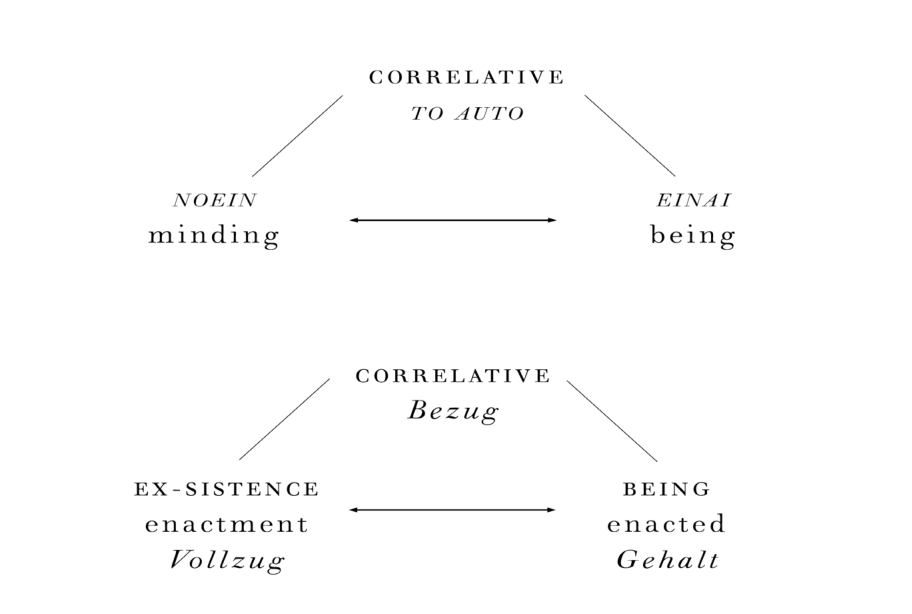
His first course as a Privatdozent (winter semester, 1915) was dedicated to Parmenides’ formulation of the correlation, where noein and einai, minding and being, are auto, inseparably correlative. Heidegger interpreted noein in terms of ex-sistence and einai in terms of being, with ex-sistence as the enactment (Vollzug), and being as the enacted (Gehalt). Heidegger took that as the bedrock of human being as such and of all Western philosophy, and for the next sixty years he did all his work within the phenomenological correlation of
- ex-sistence as enacting the being of things and
- the various forms of being that get enacted.
However, “the thing itself,” die Sache selbst of all Heidegger’s work, was neither Dasein nor Sein by themselves but rather the relation (Bezug) that renders them correlative. In 1927 Heidegger read that relation in terms of Faktizität/Geworfenheit, whereas in 1934 he began reading Geworfenheit as Ereignis.18
Another presupposition that Heidegger brings to his work (and it is a fundamental one insofar as denying it actually instantiates it)19 is that human beings are a priori embedded in meaningfulness (Bedeutsamkeit). He holds that we are not in possession of λόγος, as per Aristotle’s “the living entity that has logos,” so much as we are possessed by λόγος, as in Heidegger’s rewrite of Aristotle: λόγος ἄνθρωπον ἔχων.20 Heidegger interprets λόγος as referring primarily to “gathering into meaning” rather than to the consequences of that, such as the ability to interpret, speak, and reason (Ga 9: 279.1–7/213.10–15). As possessed by λόγος, we cannot not be making sense of whatever we encounter.
Before it is anything else, phenomenology is the correlation because that correlation is our fate. Lacking a God-like point of view, we are locked into the relation between the enactment and the enacted. We cannot experience anything without experiencing it, and we cannot understand being without understanding it. As Heidegger puts it, the philosophizing person belongs together with the matters being investigated (Ga 9: 42.25–26/36.35–36).21 Everything else in phenomenology – whether intentionality, the things themselves, the reductions, or even hermeneutics – is located within and is secondary to the correlation. The correlation structures all three divisions of Part One of Sz (= Sz I) as originally projected, just as it also structures the first Division of Part One (= Sz I.1).
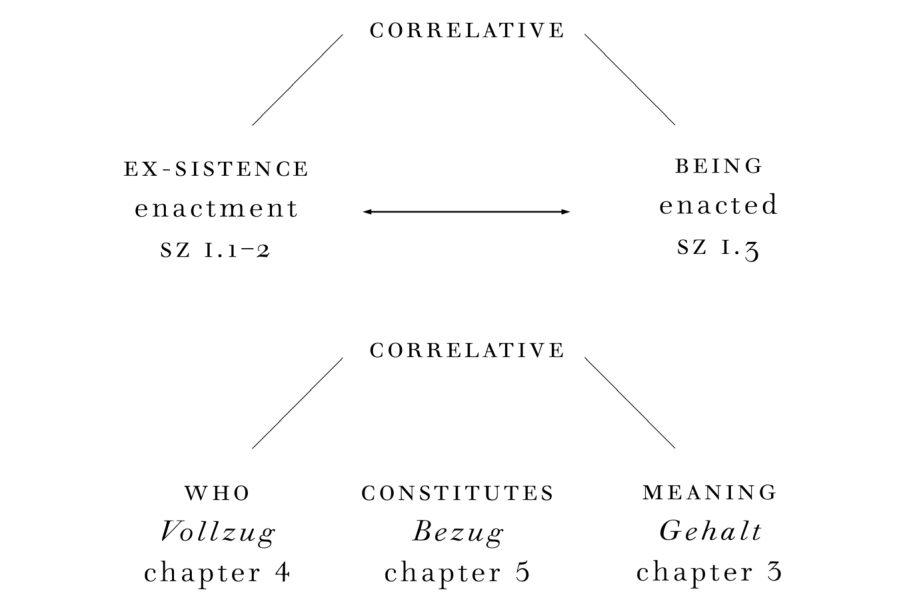
Parmenides may have been the first to articulate the correlation of minding and being, but according to Heidegger, the reason for the inevitability of the correlation eluded Parmenides and everyone else in Western philosophy until Heidegger discovered ex-sistence. Philosophers failed to probe the very correlation – the Bezug – that unites the minding-of-being and being-as-the-minded, and as Heidegger said in 1929, that relation is what he was finally after (Ga 3: 242.28–29/170.15–16).
Given the centrality of the correlation, it’s amazing that books on Heidegger’s phenomenology can still be published today without so much as mentioning the correlation.22 Even more amazing is the claim that Heidegger gave up phenomenology in the 1930s. We know he surrendered the title “phenomenology” just as he surrendered the titles “fundamental ontology” and “hermeneutics,” but he never surrendered what those titles refer to. Heidegger never gave up phenomenology, and he couldn’t without ceasing to be Heidegger.23
5. not “being”
If phenomenology is first and foremost about the correlation, it is first and foremost about meaning, intelligibility, and significance, and not at all about “being” as that word is understood in everyday speech and in philosophy. The term “being” is catnip for Heideggerians, sending them into paroxysms of ecstasy; nonetheless, in none of its forms – εἶναι, ousia, esse, entitas, and even Heidegger’s Sein – was it ever “the thing itself.” Sein is the first of those technical terms in Heidegger that do not have their usual philosophical meanings. Here we reach the pons asinorum of Heidegger scholarship, with the attendant difficulties the scholarship has had in spurring Balaam’s ass over that bridge.
Ever since (as he said) “Husserl put phenomenological eyes in my head” (Ga 63: 5.22–23/4.20),24 Heidegger saw that phenomenology was about an immediate first-person engagement with what is given in experience (das Was) in terms of the way it is given (das Wie) (Ga 2: 37.13–16/SZ 27.28–31). To use ontological terms, phenomenological experiences are of beings (das Seiende) in their being (das Sein). Such a formulation can be misleading if, as Heideggerians often do, one were to take “being” as referring to the intrinsic existence and/or essence of a thing apart from the person relating to the thing. That would be initself-ness in Aristotle’s metaphysical sense, where what we encounter is considered apart from and independent of thinking.25
Since short of death there is no escape from meaning, Heidegger understands the in-itself-ness of a thing phenomenologically as
- the meaningful presence (Anwesen, Bedeutung)
- of a thing (das Seiende)
- to the person or persons relating to that thing (das Wem)26
- within a meaning-giving context or world of meaning (Welt)
- shaped by the reason why the person or persons is relating to that thing (Woraufhin).
Sein stands for Anwesen, presence, but not in the physical or chronological sense. Instead, it means presence-to-mind, just as Parmenides’ noein means having einai present to mind.27 For Heidegger, however, “mind” refers to minding, whether that consists in caring about something (as in “Do you mind if I smoke?”) or caring for a person or thing (“Mind your little brother while I’m out”) or being attentive to a situation (as in “Mind the gap” in the London Tube). In short, Sein is Heidegger’s stand-in for the significance of something to someone within a correlation that structures the specific meaning-giving context. Sein is about how things matter to us. In fact, it is such mattering.28
That’s why Heideggerians should bite the bullet, take the pledge, and swear off the Sein-sauce once and for all, the way Heidegger himself finally did. It’s time to follow his good example and hit the pause button on what he called Seinsgerede, being-babble (Ga 5: 335.17/252.33), if for no other reason than that all that banging on about being is the greatest obstacle to understanding Heidegger’s work and to making any progress beyond it. – Nonetheless, since “being” is the term Heideggerians insist on employing, I will (reluctantly) use the word in what follows, but with the understanding that
- “being” bespeaks how entities matter to someone, i.e., their significance or meaningful presence (Anwesen), and
- “being” (Anwesen) is not die Sache selbst.
I call these remarks “Rewriting Heidegger,” but the final goal is to move beyond Heidegger to an “after Heidegger” that gets to the tasks he left undone. The thread guiding this text’s trajectory will be Heidegger’s 1971 remarks on ex-sistential movement as what makes meaning possible.
6. der sinn von sein
The first issue is der Sinn von Sein, which is usually translated as “the meaning (or sense) of being.” That German phrase in Sz has two distinct meanings, one of them enactive and the other semantic.
- The enactive sense (Vollzugsinn) is about how we must be structured and what we have to do in order to enact an understanding of being. That is the material covered in Sz I.1–2.
- The semantic sense (Gehaltssinn) is about what we understand being as. That is the material which was to be covered in the unpublished Sz I.3.
On two different occasions in 1962 Heidegger spelled out what the enactment does. In his April letter to William J. Richardson he said it brings about (erbringt) being as the meaningful presence of things (Ga 11: 151.27/xx.3).29 And in a private seminar in September of that year he said that it allows for – i.e., is responsible for – being as meaningful presence; in a word, it is das Anwesen-lassen (GA 14: 45.28–30/37.4–6). Here “lassen” does not mean letting presence occur “out there” in the world as something we might or might not run across.30 Anwesen occurs only in the enactment of Anwesen, and Heidegger’s fundamental question was what brings about that Anwesen.
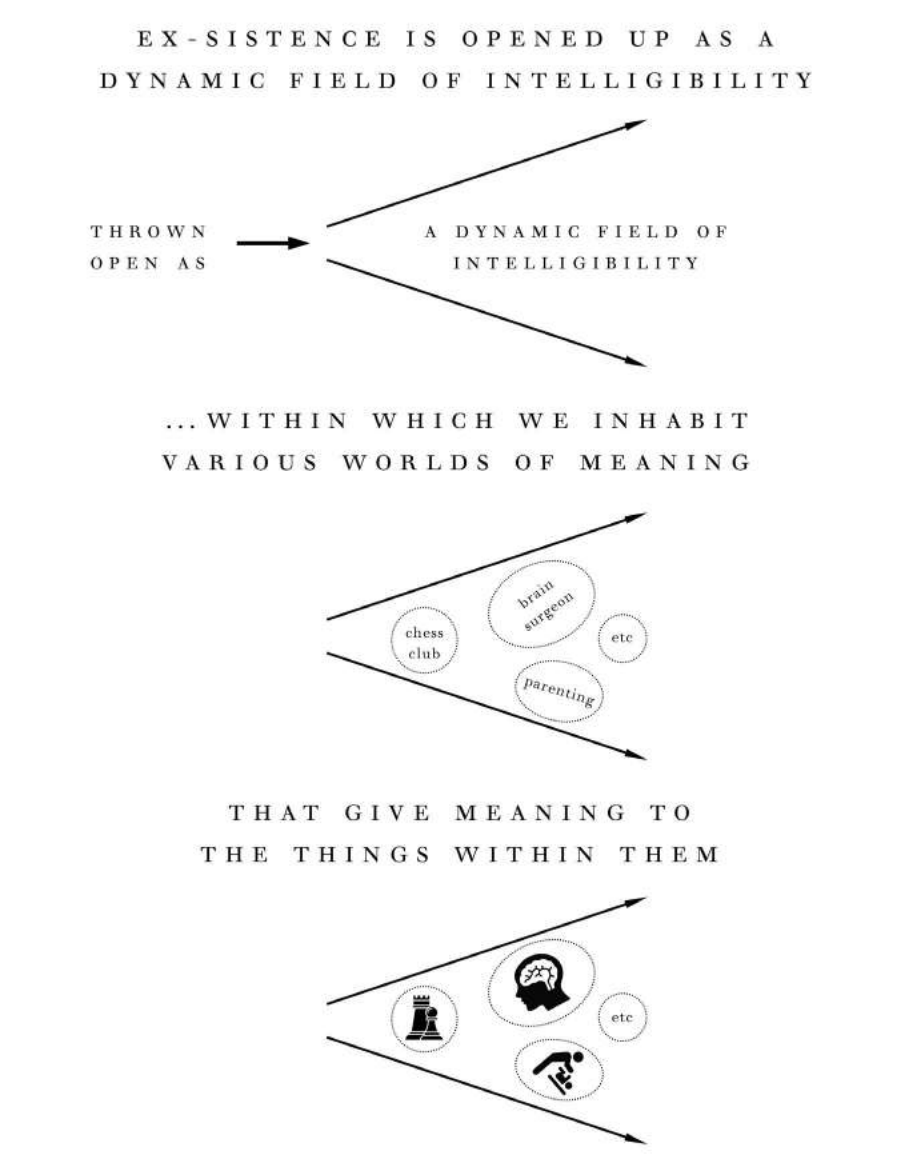
Throughout his career, Heidegger said that what brings about Anwesen is die Lichtung, the thrown-open clearing. In turn he identified that clearing with ex-sistence as enacting Anwesen.31 However, the static image of an open space in the forest fails to capture the dynamic sense of the clearing as a kinetic field of intelligibility, as per the gerundive sense of Lichtung: ex-sistence as “clearing the way” for the meaning of whatever one encounters (see Figure 3).32
Sz was published without Sz I.3, that is, without getting to the semantic side of der Sinn von Sein, what “being” means when it is enacted. But even though the book remained a torso, in 1939 Heidegger said that what Sz i.3 would have worked out is already foreshadowed in the enactive moment of Sz i.1–2 (Ga 66: 414.9–13/367.15–16 ). Hence, to discover the semantic content of “being” we have to work with what we’ve got: Heidegger’s analysis of ex-sistence as enacting the understanding of being. That analysis reaches a climax in Sz §65, which brings us to the second issue – in fact the key issue.
7. temporality and its problems
Sz §65, devoted to Zeitlichkeit and Zeit, is one of the least understood sections of the entire treatise and the worst translated. What I will call the “received interpretation” of §65 has two problems, the first regarding the terminology for temporality and the second regarding its structure. Underlying both problems is an issue I mentioned earlier: Heidegger’s retrieval of an ex-sistential-phenomenological meaning from one of Aristotle’s Greek metaphysical terms.
7.1 the terminology for zeitlichkeit
The traditional model of time (χρόνος) sees it as composed of three moments: past, present, and future. The received interpretation of §65 claims that the very same holds for temporality in Sz, so that those three chronological moments give their names to the very different ex- sistential moments of temporality. Thus, in the received interpretation, Gewesen, Gegenwart, and Zukunft get translated as, respectively,
- the past (in the sense of “what is as having been”)
- the present
- the future.
But that is egregiously wrong. For starters, Zeitlichkeit does not mean “temporality” and Zeit does not mean “time” in either the everyday or the philosophical sense of measuring the duration of a movement or an event. Heidegger said that Zeitlichkeit and Zeit were only provisional names for ex-sistence as the clearing, and he finally shelved the term Zeit in favor of Lichtung.33 Here we meet the full impact of Heidegger’s 1971 remarks about κίνησις.
Heidegger lifted the issue of time out of Aristotle’s chronological model and relocated it (provisionally) in Plotinus’ ontological model of the “distention of life” (διάστασις ζωῆς),34 which Augustine interpreted as the “distention of the spirit” (distentio animi)35 and which Heidegger reread as ex-sistence stretched out ahead of itself (die Erstreckung des Daseins) (Ga 2: 491.21/SZ 371.32). In that context, what Heidegger calls Zukunft does not refer to the “future,” all those experiences that are yet to come. Rather, it is his term for becoming yourself, asymptotically and mortally, as in das Auf-sich-Zukommen, “coming to oneself” (Ga 2: 437.4–5/SZ 330.18 ).
Then what about Gewesen? We know this term does not refer to the by-gone past, das Vergangene. However, the received interpretation insists that it means “what is as having been” in the present-perfect tense (e.g., Jones, having been born some thirty years ago, still is the child of her parents). While that chronological sense does operate in Sz §74 (re historicity), in §65 das Gewesen and die Gewesenheit emphatically do not have that meaning. Rather, Heidegger retrieved those German terms from an unsaid possibility in Aristotle’s phrase for “essence,” τὸ τί ἦν εἶναι.
When that Greek phrase refers to the essence of human being (τὸ τί ἦν ἀνθρώπῳ εἶναι), Heidegger interprets it as das Gewesen. But there’s a problem here. In his definition Aristotle uses ἦν, the imperfect verb form (third person singular) of εἶναι. If we were to (incorrectly) translate the ἦν in τὸ τί ἦν εἶναι as “was,” Aristotle’s phrase would locate the essence of human being in the chronological past. That is what the medieval scholastics did by mistranslating the Greek phase as quod quid erat esse: what it was to be this or that thing. If we were to do the same, Existenz would come out as “what it was to be a human being,” thereby reducing ontology to chronology and locating our essence somewhere in the past.
Here things get a bit complicated, and we will take it in three steps. First, we consider what Aristotle’s phrase for essence does not mean.
Only in 1976, the last year of his life, did Heidegger clarify the issue. Von Herrmann asked him about Aristotle’s use of “was” (ἦν) in defining essence, and Heidegger wrote out a note that he inserted in the copy of Sein und Zeit that he kept in his Todtnauberg cabin. That handwritten note eventually became the marginal gloss that appears in the Gesamtausgabe edition at Ga 2: 114.6, corresponding to Sz 85.17 (M-r 117.30).36 Heidegger’s gloss explains that the Greek verb for “to be” (εἶναι) does not have a grammatical form for the present perfect (“has been”). To express that tense, Aristotle resorted to a work-around and invented the phrase ἦν εἶναι, which literally – and incorrectly – might seem to refer to “what it was to be a human being.” However, Heidegger’s gloss explains:
Das griechische Verbum εἶναι kennt keine Perfektform; dieses wird hier im ἦν εἶναι genannt. Nicht ein ontisch Vergangenes, sondern das jeweils Frühere.
The Greek verb εἶναι has no form for the perfect, which here [in Metaphysics VI 1, 1025b28–29] is expressed as ἦν εἶναι. That is not an ontic past tense but rather refers to what is always and in each case [ontologically] prior.
The ἦν εἶναι in Aristotle’s phrase refers not to the chronological presentperfect, a fact that is disastrously obscured by mistranslating Gewesen/ Gewesenheit in §65 in terms of “is as having been.” If we were to do that, i.e., ascribe to the essence of a human being the temporal status of the present-perfect, we would reduce ontology to chronology while merely switching from the imperfect tense (“was”) to the present perfect (“has been”). That Heidegger refuses to do. Gewesen/Gewesenheit in §65 does not refer to what a human being is-as-having-been in a chronological sense.
Second, what Aristotle’s phrase for essence does mean. The Todtnauberg note makes it clear that τὸ τί ἦν εἶναι (and implicitly Heidegger’s das Gewesen) refers to ontology rather than to the chronological present perfect tense. The note calls das Gewesen the “a priori perfect” (apriorisches Perfekt) or the “ontological perfect” (ontologisches Perfekt), using Perfekt in the etymological sense of the Latin perfectum: what is “done unto” human beings (factum) and done “thoroughly” (per-), i.e., a priori. That is, das Gewesen, which the gloss reads as das jeweils schon voraus Wesende, refers to what is
- a priori (= schon voraus)
- ontologically operative in and determinate of … (= das Wesende)
- each one of us at each moment of our lives (= jeweils).
In §65 Heidegger fills in the content of that formal designation. He argues that this non-chronological structure bespeaks the dynamic, exsistential fact that at each moment of my life and as long as I live, I am asymptotically becoming my mortal self.37 Far from having the chronological sense of what I am-as-having-been, das Gewesen designates the ontological becoming that is my very way of being: never just present but always pres–abs-ent, stretched ahead beyond whatever actuality I may have achieved or could achieve. Der Mensch ist ein Wesen der Ferne (Ga 26: 284.18/221.17 ). I am stretched into the distance, living mortally ahead of myself.
Third, what all this means for the terminology of Zeitlichkeit. It is clear that das Gewesen and die Zukunft are not two “time zones,” one in the past or present-perfect and the other in the future (Ga 38: 118.6– 8/98.19–21). On the contrary, Zukunft names my essential, on-going exsistential becoming. Moreover, when in §65 Heidegger has the adjective gewesen modify Zukunft (Ga 2: 432.1–2/SZ 326.19), he is indicating the kind of becoming that ex-sistence is. Far from Zukunft referring to my chronological future (next year, the year after that, and so on), it is my essence, my ontological “fate,” the ever-operative becoming that I cannot not be as long as I live. This cashes out what Heidegger means by Seinkönnen as Zu–sein, viz. the fact that ex-sistence, at its most fundamental, is ability, the finite, mortal ability to keep on keeping on.38 Zukunft is ex-sistential δύναμις, which is das Entheben in das Mögliche (Ga 29/30: 528.4/363.19), my a priori condition of being thrown into the ability to keep on becoming myself until I no longer can.
Die gewesene/gewesende Zukunft of §65 is not at all chronological and does not mean “the future that has been” (as the English translations have it). Rather, it names the ontological-ex-sistential structure underlying and making possible all chronological moments, whether past, present, or future. Heidegger found such an a priori condition implicit in what Augustine called vivere moriendo, the human condition of mortal becoming.39 And in the spirit of Augustine, Heidegger introduced a new, non-chronological “tense” into ex-sistential movement: the praesens de futuris,40 the present-future, where “future” bespeaks the fact that I am ever becoming. For Heidegger there are not three distinct chronological tenses to ex-sistential becoming but an undivided continuum. Speaking in chronological terms he will say that the past is already folded into the present (Ga 2: 27.14–15/SZ 20.4–5),41 and the present, as embodying the past, is always stretched into the future. In that sense, as he says, my past “always goes ahead of me” (Ga 2: 27.29/SZ 20.17).
7.2 the structure of zeitlichkeit
We move now from the terminology for ex-sistential “temporality” to the question of its structure. Recall that Sorge is grounded in Zeitlichkeit and that the two ex-sistential structures map on to one another.42 The received interpretation tries to carry out such mapping by claiming that both Sorge and Zeitlichkeit are trivalent, supposedly composed of three moments, which in the case of Zeitlichkeit are alleged to be the past, present, and future. But in fact both Sorge and Zeitlichkeit are not trivalent but bivalent, composed of only two ontological moments. As regards Sorge, the two a priori moments are:
- being-ahead-of-oneself-in-the-meaning-giving world, and
- being meaningfully present to whatever one encounters (Ga 2: 256.3–5/192.36–37).
Note that Heidegger uses hyphens in phrase no. 1 (Sich-vorweg-schon- sein-in) in order to hold together the first moment of the bivalence as a unity of being both ahead of oneself and always already in the world of meaning – that is, not two moments but one single moment. That single moment is ex-sistence as a thrown-ahead-of-itself-as-the-worldof-meaning. In the bivalence that is Sorge, that first moment makes possible the second moment: our meaningful presence to whatever we encounter. Thus, the bivalent structure of Sorge consists of our being
- thrown open and ahead as the clearing, the dynamic sphere of intelligibility,
- such that we make sense of whatever we encounter.
In turn, the bivalence of Sorge is based on and made possible by the underlying bivalence of Zeitlichkeit. The two moments that structure
Sorge cannot be artificially stretched to fit the “three” moments that supposedly make up Zeitlichkeit, the alleged chronological past, present and future. But the bivalence of Sorge maps perfectly onto Zeitlichkeit when we see that ex-sistential temporality is likewise composed of only two moments, not three:
- a priori becoming oneself (die gewesende Zukunft) and
- thereby making sense of all that one encounters (gegenwärtigend).43
The adjective gewesen indicates that ex-sistential becoming is what we a priori are. When Heidegger replaces gewesen with the invented participle gewesend, he is emphasizing that our ex-sistential becoming is never chronologically past or present-perfect but rather is always ontologically operative.
7.3 excursus: “coming back to yourself”
What are we to make of a phrase in §65 that describes a person as zukünftig auf sich zurückkommend (Ga 2: 431.34/SZ 326.17)? The English translations make a hash of it, rendering the phrase as “[Dasein,] coming back to itself futurally” (M-r) or even worse “[Dasein,] coming back to itself from the future” (S-s). There is no way to make any sense of the English – or for that matter, of Heidegger’s German – unless one sees Aristotle’s τὸ τί ἦν εἶναι hovering in the background.
Recall that §65 is defining Zeitlichkeit not as just a neutral ex-sistential structure but rather as the authentic becoming that you personally enact when you take over your mortality in an act of resolve. That is certainly not “returning to yourself from the future” (whatever that is supposed to mean). Instead, you return to yourself (to use Heidegger’s German adverb) “zukünftig-ly,” where zukünftig has an ex-sistentielpersonal sense rather than an ex-sistential–structural one. You person- ally return to your structural becoming and take over your mortality, making it your own (zu eigen machen) and making yourself personally responsible for it (eigentlich).
In personally taking over your own way of being, you do not take over some generic human essence or species-being. Your mortal exsistence is always yours alone and yours-to-become (cf. jemeinig), and in an act of resolve you take over your own personal mortal becoming – not his or hers, and certainly not “human being in general.” You recognize and embrace the hard fact that inhabits all you have been, are, and always will be, namely that the moment you were born you were able to die, and in fact you are dying now (Ga 2: 326.25–26/SZ 245.26–27). That resolute recognition is what Sz calls “taking over your thrownness” (Übernahme der Geworfenheit: GA 2: 431.13/SZ 325.37), which Ga 65 rewrites as “taking over your appropriation” (Über-nahme der Er- eignung: GA 65: 322.7–8/254.36–37). It is a matter of ex-sistentielly becoming your ex-sistential becoming, which is what Heidegger means in Sz §31 when he cites Pindar’s γένοι’ οἵος ἐσσί: “Become what you are.”44
7.4 excursus: “making sense of”
A brief note on the phrase “making sense of,” since I use it to paraphrase both Sein bei in Sorge and Gegenwärtigen in Zeitlichkeit. Etymologically it comes from the Latin sentire, which has two distinct connotations: kinetic-directional and epistemic-semantic. When you are driving in Paris and the sign says sens unique, or in Rome where it says senso unico, that sign is indicating a one-way street, employing the kinetic-directional sense. On the other hand, when you speak of “making sense” of something, you’re employing the epistemic-semantic sense. For Heidegger, the two senses are intimately related: the kinetic-directional sense underlies the semantic-epistemic one: movement makes possible meaning. In ex-sistentially making your way forward, you open up a sphere of meaning within which you can understand things as this or that.
7.3 the semantic sense of “being”
I am arguing that Sz cashes out Heidegger’s 1971 suggestion about movement and meaning. In §41 he argues that the movement-moment (being thrown ahead as the clearing) makes possible the meaning-moment
(making sense of things), just as in §65 the movement-moment (a priori becoming) accounts for the meaning-moment (rendering things meaningfully present). In making our way (bewegen), we make sense of things (bedeuten): our mortal movement makes for meaning. But how exactly does ex-sistential movement determine what “being” means?
§65 works out two distinct modes of ex-sistential “time,” viz., Zeitlichkeit and Zeit, both of which are the same thing, namely exsistence.45 The sameness and the distinction are important, and the mediating term that Heidegger uses is sich zeitigen: ex-sistential temporality unfolds as the field of time. Sich zeitigen is Heidegger’s translation of ϕύειν, to emerge and unfold (cf. ϕύσις), something the English translations garble by rendering the phrase as “temporality temporalizes itself as time,” a sentence that says nothing and obscures everything.46
From the get-go, Heidegger had a field-theory of ex-sistence. To express that, he often used the image of a horizon, which fails to adequately capture what he means. A horizon is an imaginary line up ahead where earth and sky seem to meet, whereas Heidegger is referring to what lies on this side of the horizon: ex-sistence as the sphere of meaningfulness. That field, formed by ex- sistential becoming, is what Heidegger calls the clearing.
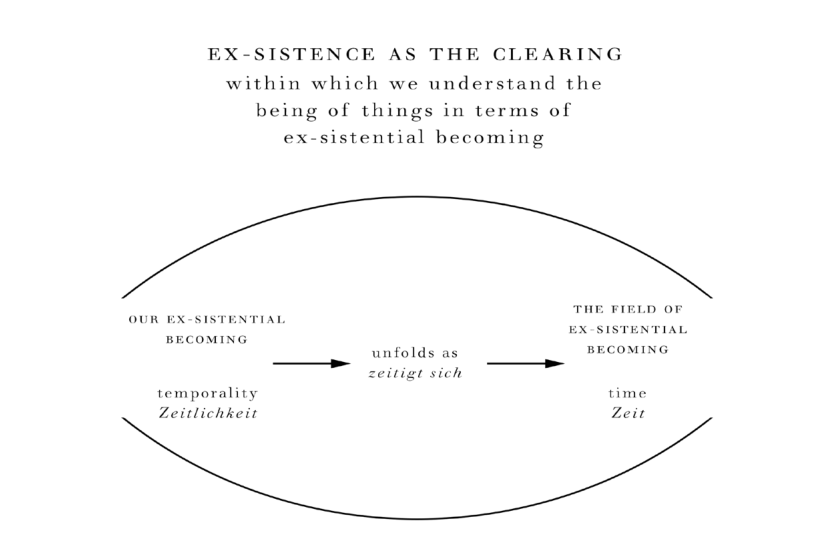
This clearing is not static. It is a Kraftfeld, a charged field of force that determines whatever appears within it. Think of a magnetic field exerting a directional force on the metal filings that fall within its scope.
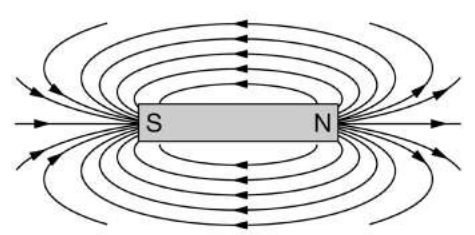
Analogously, ex-sistential time – the “field of force” into which and as which ex-sistence unfolds – is what determines the “directionality” (i.e., significance) of whatever falls within its scope.
§65 is the culmination of Sz in its published form. It establishes the thesis that is the core of Sz I.1–2 and that was to be further spelled out in Sz I.3, namely that we understand the significance of things in terms of our ex-sistential becoming – or in Sz’s terminology, “being” in terms of “time.” In §65 the picture that Sz had been drawing for some 300 pages finally becomes clear, and as it does, we see the ut- ter radicalness of what Heidegger was driving at. At this point in the book – not even a third of the way through Sz as originally projected and long before Sz II, which was to take on the history of being – Heidegger has already destroyed traditional ontology. He has dismantled being as it was imagined at the origins of Western philosophy: static, solidly grounded, identical to itself – all the characteristics (other than its correlation with minding) that Parmenides had asserted.47 He has shown that we understand everything we encounter in terms of our groundless, asymptotic becoming. This is an ab-surd fact: there is no discernible reason underlying it, we are simply thrown into it. In a way that is analogous (but only analogous) to Nietzsche, Heidegger has stamped becoming with the characteristics that traditionally accrued to being. He has done Nietzsche’s homework for him.48
Heraclitus famously said that you cannot step into the same river twice. Some fifty years later Cratylus did him one better by saying you cannot step into the same river once.49 Heidegger agrees with Cratylus: you cannot step into the same river once because there is no bank from which to step into the river. You are the river.
To speak of Heidegger’s work as a “topology” is to use far too static a term. It would be more accurate to call it a “potamology.” (Only half-kidding.) The same goes for die Lichtung as a cleared space in the woods, an image that is much too static for what Heidegger has in mind. He saw that problem and pointed out that the verb “lichten” has a dynamic sense (Ga 14: 80.16–17/65.12–13). In Sz it means “clearing the way,” which Heidegger later expressed by the verb “wëgen,” a Swabian dialect word for “to make one’s way.”50 By ex-sistentially making our way, we open up and clear a space that makes meaning possible.
Nonetheless, it is extraordinary that once Heidegger has arrived at this utterly radical thesis, he showed little interest in cashing out the details of the content-side side of the correlation, i.e., the semanticlexical question of what we understand the being of things as. It’s true that two months after publishing Sz, on Saturday, July 16, 1927, during the very last hour of the last meeting of his course on “Basic Problems of Phenomenology,” Heidegger did make a stab at working out what “being” means in at least one of its moments.51
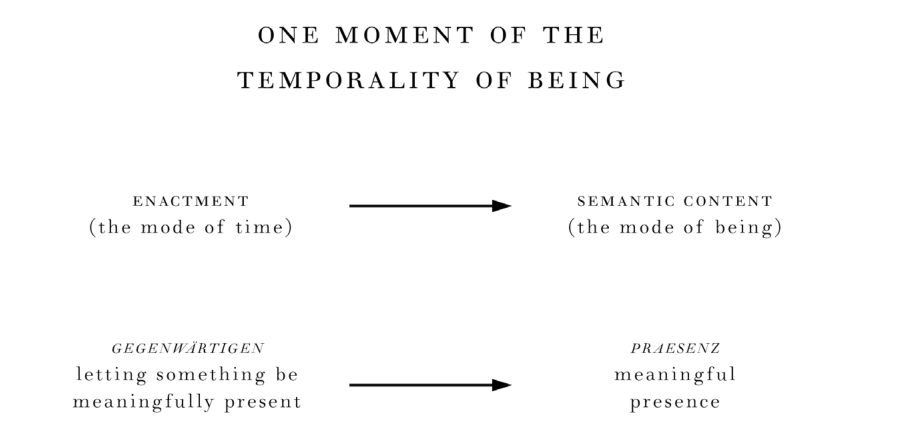
That glancing blow would be his sole attempt to work out the temporality of being, at least until the equally unsatisfying effort thirty-five years later in his lecture “Time and Being” (January 31, 1962). Moreover, in that lecture, and in the seminar he conducted on it a few months later in Todtnauberg (September 11–13, 1962), he was less interested in the enacted content of Sein than in further elaborating the enactment under the rubric of Es gibt Sein, i.e., how there is an understanding of being at all. In the end, he seemed satisfied with clarifying the Es of Es gibt Sein by simply saying that the clearing – Existenz as the kinetic field of ex-sistential temporality – brings about meaningful presence” (erbringt Anwesen). That is: ex-sistential movement accounts for all forms of meaning (Ga 11: 151.26–28/xx.31–33).
9. and the kehre?
But didn’t all that change with the so-called Kehre in the 1930s? The short answer is no. The later work confirms what Sz had already argued, namely that ex-sistence is what “gives” all forms of being.
In 1929 Heidegger said that the key issue of all his work lay hidden in the relation (Bezug) between ex-sistence and being, the “and” that holds together time and being (Ga 3: 242.28–29/170.15–16). That relation is the Lassen of Anwesenlassen, and it comes down to Existenz thrown open as (aka appropriated to be) the clearing. A couple years before drafting the “Letter on Humanism,” Heidegger wrote a note on what he called the Wahr-heit des Seyns, the “disclosed-ness of beyng” – i.e., the openness of the clearing – which he said is the most important thing we are given to contemplate (das Höchste dessen, was den Menschen zu denken gegeben). Within that issue, the richest mystery (das Geheimnisreichste) is the relation of beyng to human being (der Bezug des Seyns zum Menschen). He goes on:
Der Bezug ist jedoch nicht zwischen das Seyn und den Menschen eingespannt als seien beide vordem bezuglos Seyn und Mensch. Der Bezug ist das Seyn selbst, und das Menschenwesen ist der selbe Bezug: der entgegnende zum Gegenden des Seyns. (Ga 73.1: 790.2–8)
However, the relation is not something stretched between human being and beyng as if beforehand beyng and the human essence were two elements unrelated to each other. On the contrary, that relation is beyng itself [i.e., the clearing], and the essence of human being is that very relation, the reciprocal encounter with beyng as encountering.
Hence, he can affirm unambiguously that
das Dasein ist das je vereinzelte “es”, das gibt; das ermöglicht und ist das “es gibt.” (Ga 73, 1: 642.28–29)
Ex-sistence is the always individualized “it” [in the phrase “it gives being”]; it makes possible and is the “it gives.”
So yes, we can see how Heidegger could use Seyn as a cipher for the thing itself; however, it is only a formal indication of that issue. Once we work out the content of that formal indication, it becomes clear that beyng is ex-sistence as thrown/appropriated into the asymptotic and mortal movement that we are and cannot not be.
Because we are ever teetering at the edge of death (Sein-zum-Tode), all mattering-to-us – that is, all Sein read phenomenologically – is suffused with nothingness, both with relative nothingness (because we are finite) and with absolute nothingness (because at every moment we can become nothing). But paradoxically this nothingness that we are ever able to become is fundamentally positive insofar as, in Heidegger’s anthropomorphic image, it “pushes us back” into ex-sistence (Ga 9: 114.5–16/90.15–24).52 As we live at the chiaroscuro border between our ex-sistence and our nothingness, we are not just able to make sense of whatever we encounter, we have to. Nonetheless, all such sense is suffused with both relative and absolute meaninglessness: relative, insofar as some things just do not make sense, even though they once may have, and still might in the future; and absolute meaninglessness insofar as my ex-sistence is ab-surd – not meaningless but rather deaf (surdus) to all attempts to find an ultimate explanation for why I ex-sist. I spend most of my time trying to ignore the absolute absurdity of my ex-sistence, but sometimes it catches up with me in moments of dread.53
Even without Sz I.3 we can see the radical outcome Heidegger was driving at. He pulled out every vestige of ground from under our feet and left only the nunc fluens of becoming: human being as a question to which there is no answer.
10. beyond heidegger
Heidegger did not want more Heideggerians. He thought one Heideggerian was quite enough, thank you. What he wanted were people who would learn from him and then think beyond him. In fact, Heidegger himself wanted to think beyond Heidegger. What do I mean by that?
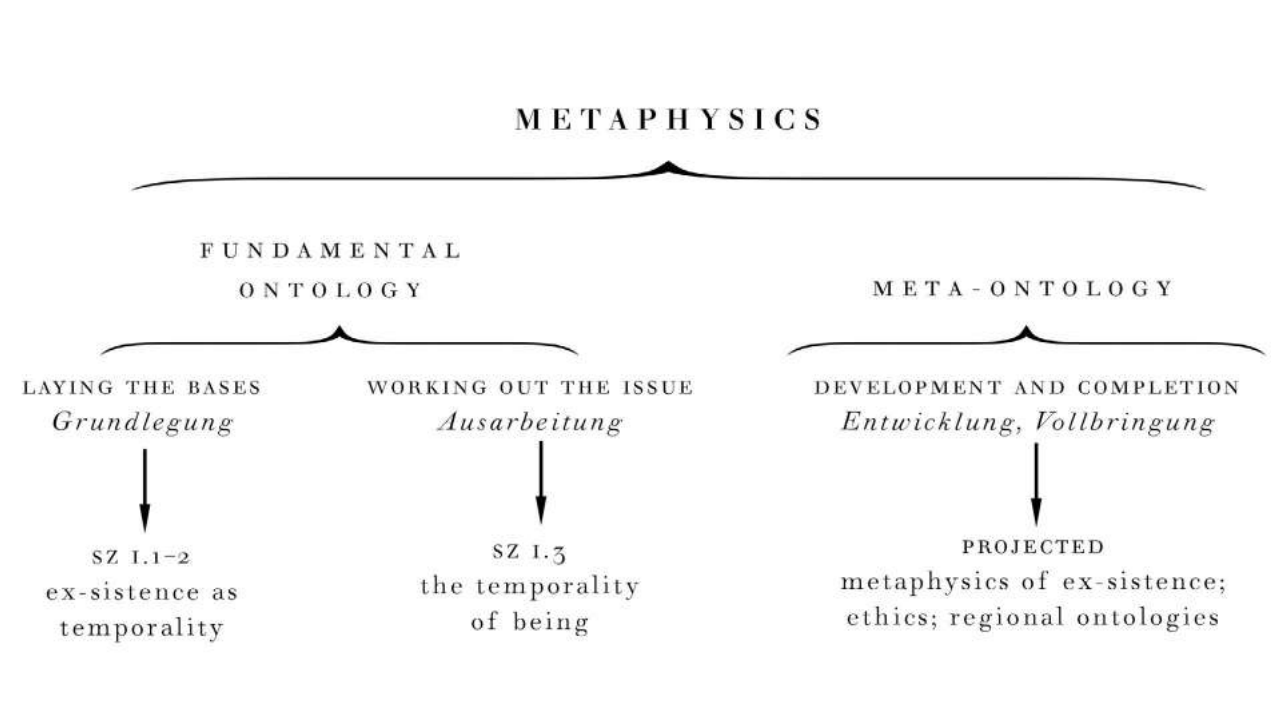
At first blush it might seem that Heidegger’s program in the late 1920s was twofold: fundamental ontology and the dismantling of metaphysics, the two Parts of Sz as projected. However, on July 12, 1928, as he was leaving Marburg to assume Husserl’s chair at Freiburg, he laid out a different plan that included a post-Sz project. In the 1920s the word “metaphysics” still had a positive sense for Heidegger (properly understood, it described his own project), and Heidegger sketched out what he saw as its full structure (Ga 26: 196–202/154–59) (see Figure 7).
With meta-ontology, he said, fundamental ontology becomes radical; it returns to its roots in the ex-sistentiel and the ontic (Ga 26: 197.34/155.34–35, 199.2/156.26). Ariadne’s thread guides us out of the cave of the temporality of being, back to ourselves where, as Heidegger famously said, the only way the question of ex-sistence gets straightened out is by ex-sisting (Ga 2: 17.9–11/SZ 12.30–31). The analyses in Sz are not an end in themselves. They issue in a protreptic to self-transformation (Ga 45: 214.18/181.7–8), a call not only to personal authenticity but to social authenticity as well. Didn’t Heidegger tell Richard Wisser in a 1969 interview that metaphysics had only interpreted the world, whereas the point is to change it (Ga 16: 703.12–14)?54
Meta-ontology was to be a step in that direction. It would make the transition from a fundamental ontology of becoming to the concrete metaphysics of human being (including ethics) and to regional ontologies of non-ex-sistential entities, all of that in the name of fulfilling what he said philosophy is ultimately about: the concretion of what it means to be human (Ga 26: 202.9–10/158.33–34). Meta-ontology brings us back from the depths of fundamental ontology and lands us in the economic, social, and political worlds where we live our daily lives.
11. non-concluding, very unscientific postscript
To return to where we started, the two questions of “what” and “so what.” Surely we can assume that after a century of scholarship replete with thousands of articles, books, and conferences, Heideggerians do know what Heidegger was after. Certainly Heideggerians have mastered the “what” question and can now ask the “so what” question about what difference all of that makes.
You remember the nineteenth-century parable about the famous German professor who wanted to save people from drowning. He was convinced that people sank beneath the waves because they had the idea of gravity in their heads. Therefore, he dedicated his whole career to driving that notion out of people’s minds and replacing it with the idea of levity. Nonetheless, he died in despair because, his best efforts notwithstanding, people continued to drown.55
Surely none of us wants to repeat that feckless gesture, hoping to save civilization (or at least philosophy) by driving the idea of metaphysics out of people’s minds and replacing it with the thought of Ereignis. Nor do we want to reenact the trahison des clercs of those German philosophers in the 1930s who never looked up from their copies of Diel’s Die Fragmente der Vorsokratiker as the world was going to hell in a handbasket. Nonetheless I wonder what Heideggerians will be discussing some twenty years from now, or even just two years from now at the one-hundredth anniversary of the publication of Sz. Will they still be picking over the bones and parsing out paragraphs of the 102 volumes of Heidegger’s Gesamtausgabe, while training up scores of graduate students to continue the grind after they’re gone? Will they be embalming Heidegger or weaponizing him?
Whatever one thinks of his efforts, Heidegger wanted to be transformational, even revolutionary. He shook the congealed tradition of ontology down to its foundations in hopes of retrieving its explosive potential – only to have his would-be revolution end up as its own congealed tradition, comfortably ensconced behind the walls of the academy where it is meticulously curated by hundreds of bien-pensants professors dedicated to filling the minds of the young with the ideas of
Seyn-with-a-y. One might be reminded of Chief Justice Oliver Wendell Holmes’s remark in 1908 that “philosophers are hired by the comfortable class to prove that everything is all right.”56
The call to personal and even social transformation is a constant drumbeat in Heidegger’s work. One way of getting in step with that would be to work out the ethics Heidegger projected in 1928. But that would require first working out the social ontology that lies buried in Sz, especially in chapter four, where Heidegger makes such radical statements as that ex-sistence is essentially for the sake of social ex-sistence (“Das Dasein ist wesenhaft umwillen Anderen”: Ga 2: 164.27–28/ SZ 123.20–21). Heidegger’s meta-ontology was supposed to investigate the “concretization” of ex-sistence-qua-ability. In the world in which we actually live, ability gets concretized in forms of power. In the economic order, for example, it takes the form of money as power, which develops into social power, which in turn becomes the political power to make sure, as Holmes said, that the established economic and social hierarchies are not disturbed. Does Heidegger’s philosophy offer any insights on that? Finding out would require pushing past his work on Aristotle’s Nicomachean Ethics and into the Politics with its analyses of exchange value (χρῆσις μεταβλητική) and its strong interest in the common good.57
* * *
In 1971 Heidegger directed a young scholar’s attention to movement, which Sz interprets as ex-sistential time. Some fifty years earlier, in 1924, he had ended a lecture on time with a set of questions that still hangs over our heads if we want to take Heidegger beyond Heidegger.
He asked:
What is time?
Or better: Who is time?
Or better yet: Are we our time?
With that last question, he said, ex-sistence begins to get interesting (“Dann wäre Dasein Fraglichsein”: Ga 64: 125.1–7/213.30–31).
appendix re: “dasein is not the whole of the clearing.”
Prof. Richard Capobianco has claimed that the Lichtung is neither the same as Dasein nor exhausted in Dasein, this based on a passage in Zollikoner Seminare, 223.13–15/178.4–5 that reads: “Er [der Mensch] ist nicht die Lichtung selber, ist nicht die ganze Lichtung, ist nicht identisch mit der ganzen Lichtung als solcher.”
In a private communication (June 26, 2018) Friedrich-Wilhelm von Herrmann clarified that passage. He wrote:
Wenn also das Sein selbst, die Wahrheit des Seyns, sich in einer geschichtlichen Lichtungs- oder Entbergungsweise bekundet und verbirgt, gewährt und entzieht, dann „er- schöpft sich“ das Sein selbst, die Wahrheit oder Lichtung des Seyns, nicht in der jeweiligen Gelichtetheitsweise des Da, sondern bleibt seinem Wesen nach das Unerschöpfliche für alle endlichen Lichtungs- oder Entbergungsweisen. Auf derselben Ebene des Denkens hält sich die von Ihnen angezogene Textstelle aus Ga 97: 175.12–19.
That is:
Being itself, the disclosedness of beyng, both shows and conceals itself, gives and withdraws itself, in this or that historical clearing and manner of disclosure; thus being itself, the disclosedness or clearing of beyng, is not “exhausted” in any particular way that the clearing is cleared. Rather, by its very nature it remains inexhaust- ible as regards all finite forms of the clearing and disclosure. The text you referenced – Ga 97: 175.12–19 – is in the same train of thought.
The passage in question at Ga 97: 175.18–20 (not .12–19) reads:
es [= Dasein] lichtet und hält die Lichtung des Seins aus, was es, das Dasein, nur vermag, insofern es als Lichtung (“Da”) des Seins west und so “das Da” “ist”, d. h. Da-sein.
That is:
[Dasein] clears and sustains the clearing of being, which Dasein can do only insofar as it is present as the clearing/Da of being and thus “is” “the Da,” i.e., Da-sein.
Notes
Chess piece vector icon in figure three is from vecteezy.com. Brain icon is by Svelte Ux, and diaper changing icon is by Adrien Coquet; both were downloaded from thenounproject.com.
- Re Dasein: Ga 65: 300.13/237.6–7; Ga 49: 62.1/48.18. Re Ereignis: Ga 11: 45.17–19/36.16–17. Note: The references to the Gesamtausgabe and its translations as well as the spelling of exsistence follow the pattern in Thomas Sheehan, Making Sense of Heidegger (Rowman and Littlefield International, 2015). “Mr” abbreviates “Macquarrie-Robinson,” and “s-s” abbreviates “Stambaugh-Schmidt.” For all texts by Aquinas, see https:// www.corpusthomisticum.org/oee.html. The present text was first delivered as a lecture and retains its spoken style. ↩
- Re “event”: Ga 11: 45.19–20/36.18–19; Ga 12: 247.9–10/127.25–7; Ga 14: 25.33–26.1/20.29–33; cf. Ga 70: 17.19–22/9.22–24. Re “beingthere/being-here”: Ga 15: 204.7/126.16; Ga 71: 211.2–5/180.20; Heidegger, Lettre sur l’humanisme, trans. Roger Munier, new, revised edition (Paris: Aubier, 1964), 182.29–184.3 (in the 1957 edition, 178.29–180.3). ↩
- Mark Twain, “The Awful German Language,” in A Tramp Abroad (London: Chatto and Windus, 1880), 603.39–604.2, translating “…wenn er aber auf der Straße der in Sammt und Seide gehüllten, jetzt [sehr] ungeniert nach der neuesten Mode gekleideten Regierungsrätin begegnet….” from Eugenie Marlitt (= Eugenie John), Das Geheimnis der alten Mamsell, 2nd edition (Stuttgart/Berlin/Leipzig: Union Deutsche Verlagsgesellschaft), 1890, 303.21–23 (originally, Leibniz: Gartenlauben-Verlag, 1868). ↩
- Respectively, Ga 9: 273.8/208.35; Ga 5: 71.16/53.24; Ga 26: 199.27/157.7 and 196.12/154.21. ↩
- On Sein as intelligibility: Ga 19: 205.13–14/141.33–34 and Sz 12.14– 15 vs. Ga 2: 16.23. ↩
- However, his use of “Seyn” is notoriously ambiguous in the later work. ↩
- See GA 73.1: 642.28–29 and 790.2–8. On primary and secondary intelligibility: Ga 2: 201.22–30/SZ 151.31–38. – After the publication of Karl Jaspers’ Philosophie in late 1931, Heidegger generally stopped using “Existenz” lest it be confused with Jaspers’ sense of the term, and in its place began using “Inständigkeit.” Cf. Friedrich- Wilhelm von Herrmann, Hermeneutische Phänomenologie des Daseins. Ein Kommentar zu “Sein und Zeit” (Frankfurt am Main: Vittorio Klostermann, 2008), iii, 265.29–33. ↩
- See Ga 65: 34.9/29.7; 239.5–6/188.25; 252.23–25/199.3–4; 304.5– 9/240.16; 322.7–8/254.36–37 (the last text to be compared with Ga 2: 431.13/SZ 325.37), and also, Ga 9: 377 note d/286 note d. ↩
- Richard Polt and Gregory Fried, eds., After Heidegger? (London: Rowman & Littlefield International, 2018). ↩
- “Jedes Suchen…aus dem Gesuchten her”; cf. Plato, Meno, 80d5–8. ↩
- See Ga 21: 170–181/143–154. ↩
- Aristotle, De coelo et mundo I 5, 271b8–9. See also Plato, Cratylus, 436d2–4 and Aquinas, De ente et essentia, Proemium, ad initium. ↩
- Respectively, Aristotle, Physics, III 2, 201b33–202a3: χαλεπóν, and Ga 9: 283.23–27/216.27: das Schwierigste. ↩
- Aristotle, Physics III 1, 200b12–15: ἀγνοουμένης αὐτῆς ἀγνοεῖ− σθαι καὶ τὴν ϕύσιν. Cf. Aquinas: “ignoto motu, ignoratur natura,” In Octo Libros Physicorum, n. 276. ↩
- Aristotle, Physics III 201a10–11, 201b4–5, etc. ↩
- Ga 62: 343–400/155–74; originally edited by Hans Lipps, Dilthey- Jahrbuch für Philosophie und Geschichte der Geisteswissenschaften, VI (1989) 235–274. ↩
- “Wie du anfingst, wirdst du bleiben.” Friedrich Hölderlin, “Der Rhein,” in Selected Poems and Fragments, trans. Michael Hamburger, ed. Jeremy Adler (London: Penguin, 1994), 48. T.S. Eliot, “Little Gidding” v, in The Complete Poems and Plays of T.S. Eliot, ed. Valerie Eliot (London: Faber and Faber, 1969). ↩
- See note 8. Re 1934 cf. Heidegger’s letter to von Herrmann, February 20, 1964, Heidegger Studies 39 (2023), 284.1–3 ↩
- For argument by retorsion (περιτροπὴ τοῦ λόγου) see Sextus Empiricus, Πυρρωνειῶν ὑποτυπωσεῶν (Outlines of Pyrrhonism) in Sexti Empirici Opera, ed. Hermann Mutschmann and Jürgen Mau (Leipzig, Teubner: 1912), ii, 128. ↩
- Aristotle, De Anima, III 9, 432a31, etc. Heidegger’s rewrite: Ga 40: 184.11/195.11. Cf. also Ga 12: 230.2/112.7–8. ↩
- “zu den Sachen der Philosophie der Philosophierende selbst… mitgehört”; GA 9: 103.20/82.16: “der Fragende – als ein solcher – in der Frage mit da.” ↩
- See William McNeill, The Fate of Phenomenology: Heidegger’s Legacy (Lanham: Rowman and Littlefield, 2020). ↩
- Heidegger’s polemics against “phenomenology” in Ga 82 (e.g., 37f., 43, 45, 82, 146, 189, etc.) are directed against a certain way of doing phenomenology, not against Heidegger’s own hermeneutical phenomenology. ↩
- Cf. also Ga 14: 147.31–32/201.14–15. ↩
- Aristotle, Metaphysics XI 8, 1065a24: τὸ ἔξω ὂν καὶ χωριστόν. Cf. ἔξω [τῆς διανοίας] “outside” [i.e., independent] of thinking: ibid., VI 4, 1028a2, taken with 1027b34–1028a1. ↩
- Ga 87: 101.4: “wem zeigt sich das ‘Sich’-zeigende.” ↩
- Cf. Aquinas, “praesens intelligibile,” Scriptum super sententias, lib. 1, d. 3 q. 4 a. 5; and Kant, Critique of Pure Reason, a249: “coram intuitu intellectuali.” ↩
- Cf. Robert B. Pippin, The Culmination: Heidegger, German Idealism, and the Fate of Philosophy (Chicago: University of Chicago Press, 2024), 14–15, 25.14, etc. ↩
- “Lichtung des Sichverbergens (Zeit) erbringt Anwesen (Sein).” ↩
- As at Zollikoner Seminare 223.1–4/177.30–31: “Es gibt Anwesen, das den Menschen nicht braucht” – but that is not the Anwesen that Heidegger studies in his work. ↩
- A far from exhaustive list (I cite only the German pages and lines) would include Ga 2:87.2–4/64.22–24, 177.7–8/133.5, 503.13– 14/380.27–28 (etc.); Ga 3: 229.10–11; Ga 6.2: 323.14–15; Ga 9: 325.20– 21; GA 14: 35.23–24; Ga 15: 380.11–12 and 415.10–13; Ga 45: 213.1–4; Ga 66: 129.5, 321.12, and 328.1–2; Ga 69: 101.12–13; Ga 70: 125.12; Ga 731: 450.13 and 642.27–28; Zollikoner Seminare, 351.14–17; etc. On Prof. Capobianco’s contrary claim, see the Appendix to this text. ↩
- Cf. Ga 12: 249–250, esp. 249.19–25/129–30: wëgen, Be-wëgung, Be- wegen, Wëg; also Ga 74: 46.6 and .11; and Ga 9: 291.19–20/222.32: “ein Weg führt durch einen Bereich, öffnet sich selbst und eröffnet diesen.” ↩
- Re provisional names: Ga 9: 159 note a/123 note a, and 376.11/285.26–28; Ga 54: 113.25–33/77.10–15; Ga 65: 74.10–12/59.26– 28; Ga 66: 145.25/124.6; 146.8/124.25; 300.13–23/268.5–25; etc. On shelving “Zeit” in favor of “Lichtung” see Ga 11: 151. 27/xx.33. ↩
- Plotinus, Ennead III 7, 11.42 ↩
- Augustine, Confessions, XI 26, 33. Patrologia latina (pl), 32, 822.47–49. ↩
- Heidegger is glossing the phrase “ein apriorisches Perfekt, das die Seinsart des Daseins selbst charakterisiert.” See von Herrmann, Hermeneutische Phänomenologie des Daseins, ii, 175–76. In the S-s version of Sz, Ga 2: 114, note “a,” is translated (and partially mistranslated) at p. 83, note. ↩
- The asymptotic nature of this becoming is what Heidegger finds in Heraclitus’ hapax legomenon from the Suda: Ἀγχιβασίη (fragment 122): approaching without ever arriving (see Ga 77: 2.1/1.1). Compare Stephen Dedalus’ “almosting it.” James Joyce, Ulysses, ed. Hans Walter Gabler, (New York: Vintage Books, 1986), 39.360. ↩
- Ga 2: 56.11/SZ 42.4 and GA 2: 115.25/SZ 86.16. That is also what Heidegger means by Möglichkeit when used in the singular for Existenz. Seinkönnen is usually mistranslated as “potentiality for being” as if it indicated what we could be. On the contrary, it names what we cannot not be: the self-enacting ontological ability to keep on ex-sisting mortally. Imperfect translations in other languages include: French, pouvoir-être; Italian, poter-essere; Portuguese: poder ser; Spanish: poder-ser; Greek, δυνατότητα, possibility; Chinese: 能存在 (néng cúnzài): able to exist; etc. ↩
- Augustine, Epistula 95, no. 2. pl, 33, 352.38. ↩
- Augustine, Confessions XI 20, 26. PL, 32, 819.24. ↩
- As William Faulkner’s Temple Stevens puts it, “The past is never dead. It’s not even past.” William Faulkner, Requiem for a Nun (London: Vintage, 2015), 85.15. ↩
- “Sorge” does not refer to “care” as a personal, psychological concern for someone or something. As Sz §41 shows, it means being a priori “given over” (cf. Hingabe) to making sense of things. See Ga 2: 264.3/SZ 199.8 and Heidegger’s footnote thereto. Further on Hingabe see Ga 20: 420.2–4/303.19, and Ga 60: 204.17/151.5 re Confessions X 27 (38). To emphasize that Sorge is structural-exsistential and not psychological-ex-sistentiel, the later Heidegger speaks of this a priori condition as “thrown unto us”: Zuwurf, Ga 66: 224.13/198.21. Cf. Ga 97: 117.2: Zuruf. ↩
- Cf. Ga 2: 432.3/SZ 326.20–21: “Dies dergestalt als gewesend-gegenwärtigende Zukunft einheitliche Phänomen nennen wir die Zeitlichkeit.” ↩
- Pindar, “Pythian Odes,” II, 72, in The Works of Pindar, ed. Lewis Richard Farnell (London: Macmillan, 1932), III, 56; Ga 2: 194.3/SZ 145.41. See also Ga 56/57: 5.35/5.14: “Mensch, werde wesentlich!” ↩
- Among other examples, see Ga 24: 388.26/274.24: “die Zeit als Zeitlichkeit.” ↩
- Zollikoner Seminare 203.7–8/158.10–11: “Zeitigung als Sichzeitigen ist Sich-entfalten, aufgehen und so erscheinen,” that is: “Sich zeitigen” = “to unfold of itself, to emerge and show-up-as….” The verb is mistranslated at M-r 377.1 352.2, 377.1, 378.33, etc.; S-s 314.3, 291.16, 31518, etc. ↩
- Parmenides, fragment 8: motionless (ἀτρεμές), unending (ἀτέλε− στον), ungenerated (ἀγένητον), indestructible (ἀνώλεθρον), now, always the same, one, and continuous (νῦν, ὁμοῦ πᾶν, ἕν, συνεχές). Instead of the everlasting (αἰώνιος), Heidegger leaves us with the sudden (ἐξαίφνης). In place of a beatific vision of being, we are left with the rare moment of insight (καιρός). Parmenides’ wellrounded circle (cf. εὐκυκλής, I, 29) has been broken. All that is solid has melted into air. ↩
- Cf. Wille zur Macht, no. 617: “Dem Werden den Charakter des Seins aufzuprägen.” Friedrich Nietzsche, Sämtliche Werke: Kritische Studienausgabe, new edition, ed. Giorgio Colli and Mazzino Montinari (Berlin: De Gruyter, 1999), xii, 312. ↩
- Heraclitus, Fragment 91: ποταµῷ γὰρ οὐκ ἔστιν ἐµβῆναι δὶς τῷ αὐτῷ. Cf. Plato, Cratylus 402a9–10 and Aristotle, Metaphysics IV 5, 1010a15. ↩
- See footnote 32 above. ↩
- See Ga 24: 431–445 and Sheehan, Making Sense of Heidegger, 201–06. ↩
- Ga 9: 114.5–16/90.15–24. This Abweisung is what Heidegger glosses as “Nichtung” in the sense of “Das Nichts selbst nichtet,” which the English translation (“nihilation” and “nihilates”) fails to capture. Nothingness is the radical alternative to ex-sisting. Hence as long as we are not dead/nothing, we are thrown into (“pushed back into”) ex-sisting. ↩
- Cf. Eugenio Montale’s “Forse un mattino,” in Ossi di seppia: Tutte le poesie, ed. Giorgio Zampa (Milan: Mondadori, 1984), i, 42: “il nulla alle mie spalle, il vuoto dietro / di me.” ↩
- Not exactly, although he should have. ↩
- “Vorrede [Entwurf]” to Deutsche Ideologie. Manuskripte und Drucke, ed. Ulrich Pagel et al. in Marx Engels Gesamtausgabe (MEGA), (Berlin: De Gruyter, 2017), I, 5: 3.27–34. ↩
- Oliver Wendell Holmes to Frederick Pollock, June 17, 1908, in Holmes-Pollock Letters, ed. Mark DeWolfe Howe (Boston: Harvard University Press, 1942), i, 139.16–17. ↩
- Aristotle, Politics, I 9, 1257a9–10 and III 7, 1282b17–18; and Nicomachean Ethics, IX 2, 1160a11–12. Heidegger’s neuralgia towards anything like a democratic polity is reflected in his cathexis on the words Homer places in Odysseus’ mouth: “Governance by the many is not good. Let there be only one leader”: Iliad II, 204–05; cf. Metaphysics XII 12, 1076a7. In the 1930s Heidegger apparently got his wish. ↩